The greater the capacity, the greater the responsibility? The ability to do it does not mean that it should do it — it has become Microsoft’s latest warning to the 10 users of Windows. Although Microsoft has been pushing users to upgrade to a new and safer system, there are still a number of users who have a lack of interest in Windows 11, after all, “Windows’ best version is the discontinued version”.
In this context, Microsoft issued an emergency update to repair the inability of Win10 users involved in the extended security update to install the November key patches. Microsoft explained: “As a result of the installation of the 14 October 2025 update, the Windows Update Settings page may be wrong to show ‘your Windows version has terminated supporting’ tips. According to Bleiping Company, Microsoft has addressed the failure of the extended security upgrade installation through the urgent updating of KB5072653. Microsoft states: “The installation of the pre-package will allow for the deployment of a security update on 11 November 2025”. If PC is unable to install the Win 10 extension security update, the emergency patch will need to be used immediately, and the security update this month includes critical repairs for Win 10.
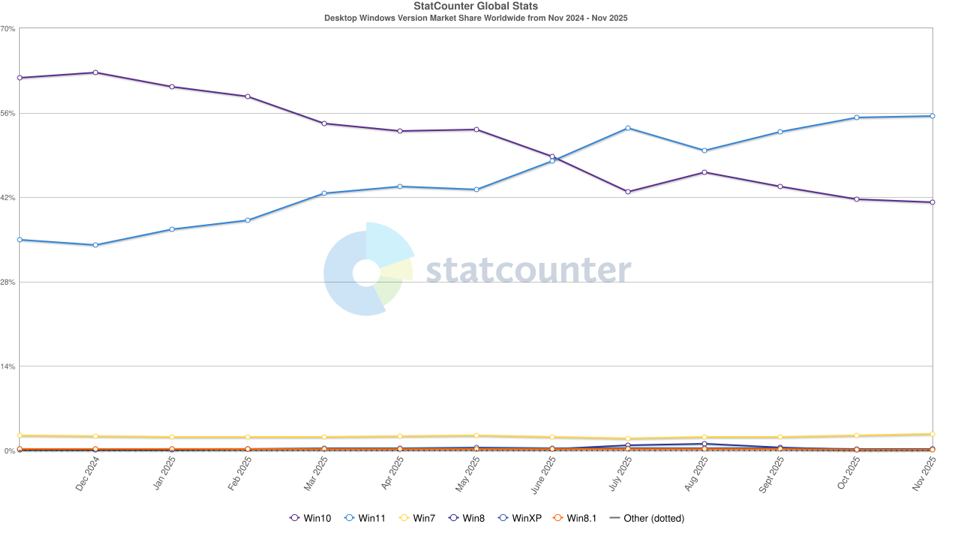
Although Microsoft allows business and household users to continue to use Win 10 for at least one year (a paid enterprise may be longer), the company has not given up the promotion. Microsoft emphasizes: “The new Win 11 Professional version of PC can reduce the incidence of safety incidents by 62 per cent by default, by opening up the latest security updates and hardware-level protections.” Microsoft claims that Win 11 has a “safe design, default protection” character, provides “opening multiple layers of protection” against network threats through state-of-the-art voucher protection, and “defaultly achieves comprehensive data protection from chips to clouds through hardware-level security, enhanced privacy settings and fine IT control”. However, users did not buy, and Win 10 market share remained stable at over 40 per cent, with little volatility since the end of service on 14 October. The reality is that more users choose to install emergency upgrades rather than upgrades, precisely the situation that Microsoft least wants to see. Even more ironically, according to Windowscentral, Microsoft recently issued an important security alert regarding its intelligent AI function, which is about to land on Windows 11. In the newly released supporting documents, Microsoft explicitly requires the user to ” only enable this function with a full understanding of the security implications” and confirms that it will be defaulted to shut down due to potential risk.
For months, Microsoft has continued to advance planning for the gradual evolution of Windows 11 into a smart-body operating system, although this concept has raised a number of doubts among network users. Microsoft confirms that “the set-up can only be enabled by the equipment administrator and will be effective for all users of the equipment (including other administrators and standard users) once it is activated”. When functionality is enabled, the system will create local user accounts for different AI smarts that will get access to individual user folders. “The smart body account has limited access to the user profile directory (C:\Users\ username\) when running in the workspace. When intelligents need access to the directory file, the system will grant read and write permission to the following common folders: document, download, desktop, video, picture, music. Microsoft recently released a long text detailing the mechanisms for the operation of the AI smart body in Windows 11: supporting AI-driven applications to perform assignments on behalf of users through new smart body workspaces. These intelligent bodies will operate in a separate, secure desktop environment, while maintaining access to user applications and files.

In particular, Microsoft warns that smart body functions are not without risk: “AI applications may give rise to new security threats, such as cross-tip injection attacks — malicious elements embedded in UI elements or files may overwhelm smart body instructions, leading to accidental data leakage or malicious software installation.” To this end, Microsoft has developed a number of design principles for intelligent body experience: to ensure that AI remains observable at all times, and that any decision-making must be approved on a manual basis. “A smart body must be able to generate detailed activity logs, and the system needs to verify all operations by tampering with the audit logs.” Microsoft ‘ s Windows 11 preview, which indicates that the collection supports the intelligent function, was sent to Insider users on 18 November, but there is currently no AI application to support the functionality. The company has confirmed that Copilot will soon fit the workspace of Windows 11 and other AI applications are expected to follow. Whether we accept it or not, the time has come for Windows as a smart body operating system.